
D-Day for Families: The Story of June 6, 1944 and the Places Where Kids Can Experience It


My grandfather, Sergeant Peter Farley, landed at Omaha Beach about twelve days after D-Day. He was a communications sergeant in the 83rd Infantry Division. On July 4, 1944, the day his division launched its first major offensive south of Carentan, he was wounded by grenade shrapnel. He recovered, rejoined his unit that winter in the Ardennes, and came home.
I've stood on the beach where he landed and walked the towns near where he fought. And recently, in Amsterdam, I stood in the Anne Frank House looking at a map of Normandy that Otto Frank had pinned to his family's hiding-place wall, tracking the same advance my grandfather was part of. I was looking at the same war from the other side of the same map.
That experience shaped this post. World War II is one of only a handful of events in history that touched virtually every family on Earth at the same time. Almost every family has a thread that connects to it somehow: a great-grandparent who served, a town that was bombed, a border that moved, a family that fled. Which means that almost everywhere your family travels, the story is there, and most of it is still findable.
Here's what happened on June 6, 1944, told in a way you can share with your kids, and six places where your family can go to learn more.
What happened on D-Day
By the spring of 1944, Nazi Germany had occupied most of Western Europe for four years. France had fallen in 1940. The Netherlands, Belgium, Denmark, and Norway were under German control. Something had to break the occupation from the west.
The plan was called Operation Overlord, the largest amphibious invasion in the history of warfare.
On the night of June 5th, more than 24,000 American, British, and Canadian paratroopers dropped into Normandy in darkness, landing behind enemy lines to destroy bridges and communications before the beach landings began. General Dwight D. Eisenhower, the Supreme Allied Commander, had written a note that afternoon accepting full personal responsibility if the invasion failed. He kept it in his pocket. Fortunately, he never needed it.
At 6:30am on June 6, the sea landings began. Nearly 160,000 Allied troops crossed the English Channel on more than 5,000 ships, supported by 13,000 aircraft, and landed on five beaches along a 50-mile stretch of the Normandy coastline: Utah, Omaha, Gold, Juno, and Sword.
Omaha was the bloodiest. American forces faced heavily fortified German positions on the cliffs above the beach, and the aerial bombardment meant to weaken those positions had missed in the clouds. Soldiers crossed 200 yards of open beach under fire. More than 2,400 Americans became casualties at Omaha on June 6 alone.
By the end of that single day, more than 9,000 Allied soldiers were killed, wounded, or missing. At least 4,414 of them were dead. They had gained a foothold on the continent and nothing more. The slow, brutal fight through Normandy and across France lay ahead.
Paris was liberated on August 25, 1944. The Netherlands on May 5, 1945. Germany surrendered on May 8, 1945. The war in Europe ended eleven months after those soldiers crossed the beach that morning.
A detail kids remember: the cricket clicker
The American paratroopers who jumped into Normandy in the dark, hours before the beach landings, couldn't see each other and couldn't risk calling out. So each one carried a tiny metal toy that made a clicking sound, like a cricket. If a soldier heard someone moving nearby in the dark, he would click once. If the answer came back as two clicks, it was a friend. If there was no answer, it was not. They only used the crickets for the first night of the invasion, then threw them away so the enemy could never learn the trick.
What D-Day meant for the people in hiding
When D-Day happened, Anne Frank was 14 years old and had been hiding in a concealed annex above her father's warehouse in Amsterdam for nearly two years. She turned 15 six days after D-Day, still in hiding.
Otto Frank found a map of Normandy and pinned it to the wall. Each day he tracked the Allied advance, moving the pins forward as the liberation inched closer. Anne wrote in her diary that she was full of hope. She believed she might walk free before the year was out.
On August 4, 1944, eight weeks after D-Day, someone betrayed the family's location. They were arrested that morning. The Allied advance did not reach Amsterdam in time. Anne Frank died in Bergen-Belsen concentration camp in February or March 1945, weeks before the camp was liberated.
The map with the pins was still on the wall when Otto Frank, the only one of the eight to survive, returned after the war. It is still there today.
Six places where families can experience the history
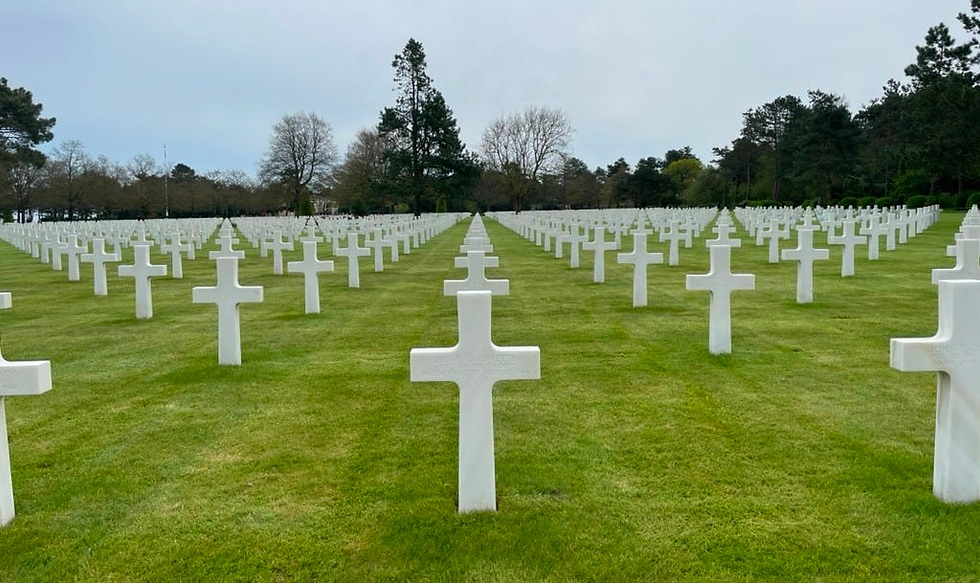
Normandy American Cemetery and Memorial Colleville-sur-Mer, France
The cemetery sits on a cliff overlooking Omaha Beach. From its edge you can see the beach below and the English Channel beyond it, and you understand immediately what the soldiers crossing that water were facing. 9,389 Americans are buried here, most killed during the D-Day landings and the Normandy campaign. A further 1,557 names are inscribed on the Walls of the Missing.
Visiting with children takes some preparation. The rows of white crosses and Stars of David stretch further than you can see from any single point. The visitor centre has detailed exhibits on the D-Day timeline and the stories of individuals buried here. Every cross has a name, a rank, a state, and a date. History is not abstract here.
Free admission, open daily. Timed entry registration is now required at abmc.gov. Located about 15 minutes from Bayeux by car. Allow at least two hours.

Utah Beach Museum Sainte-Marie-du-Mont, France
Utah was the westernmost of the five D-Day beaches. The museum sits directly on the sand and tells the story of the landing in exceptional detail, with original equipment, vehicles, and veteran testimonies. Outside, a Sherman tank and a landing craft sit near the waterline where the landings happened.
Standing on the beach and looking out at the water is a different experience from reading any description of it. For families, Utah Beach pairs well with the American Cemetery: Omaha is the better-known beach, but the two sites together give a fuller picture of June 6, 1944.
Check utah-beach.com for hours and prices.

Anne Frank House Amsterdam, Netherlands
Eight people hid in this building for 761 days. The entrance is through the bookcase. You walk up steep stairs into rooms preserved as they were found after the war. Anne's height marks are still on the wall. Otto's map of Normandy with its pins is still there.
The museum recommends a minimum age of 10, and a special audio tour for ages 10 to 15 tells the story from Anne's perspective. Book well in advance: tickets are released every Tuesday at 10am Amsterdam time for the week six weeks later, and they sell out within minutes. There are no door sales.
Adults EUR 16, youth (10-17) EUR 7, children under 9 EUR 1, exclusively at annefrank.org. One tip from our visit: if you have a Museumkaart, admission is covered, but you still need to book a time slot in advance for EUR 1.

Overloon War Museum
Overloon, Netherlands
In October 1944, four months after D-Day, Allied forces fought the Battle of Overloon, one of the largest tank battles of the western campaign. The museum was built on the battlefield itself and holds one of the largest collections of WWII military vehicles and equipment in Europe, most of it original.
I walked this site recently. Tanks, armoured vehicles, artillery, and aircraft sit across a large site in the landscape where the battle was actually fought. For kids who find the weight of a cemetery or a hiding place difficult to process, Overloon offers a different way into the same events.
Check oorlogsmuseum.nl for hours and prices. About 90 minutes from Amsterdam by car.

American Heritage Museum Hudson, Massachusetts
For families in New England who can't get to Europe, this is the most immersive WWII experience on the East Coast. The museum holds a remarkable collection of restored military vehicles, including Sherman tanks, a Chaffee, a Jackson Tank Destroyer, and a Stuart. On Tank Demonstration Weekends, the vehicles run.
When a Sherman tank moves past you on the demonstration field, the engine noise is at a frequency you feel in your chest. Reenactors in period uniforms operate the vehicles and answer questions. I've been, and my strongest memory is standing next to a fully restored Mercedes G4 staff car, the same model German high command used, close enough to see my reflection in the chrome.
Check americanheritagemuseum.org for demonstration dates and prices. About one hour west of Boston.
National WWII Museum New Orleans, Louisiana
The largest WWII museum in the United States and one of the finest history museums in the world. It covers every theatre of the war with original aircraft, vehicles, personal letters, oral histories, and immersive environments. The D-Day galleries are exceptional, and the Road to Berlin and Road to Tokyo exhibitions trace the full arc of the war.
For families visiting New Orleans, this museum deserves a full day. For older kids it is one of the most powerful educational experiences available anywhere in the US.
Check nationalww2museum.org for hours and prices. Located in the Warehouse District.
Planning a WWII history trip with kids
A few things we've learned traveling to these places as a family:
Match the site to the kid. Cemeteries and the Anne Frank House land hardest with kids 10 and up. Museums with vehicles and equipment, like Overloon and the American Heritage Museum, work for younger kids who connect through machines before they connect through stories.
Tell the story before you go. A child who knows about the cricket clickers before standing on a Normandy beach has a completely different experience from one who's told to be quiet and walk slowly. Ten minutes of storytelling in the car changes the whole visit.
One site per day. These places are emotionally heavy, even for adults. A cemetery in the morning and a museum in the afternoon is too much. Pair a heavy site with a beach afternoon or a playground.
Look closer to home. WWII left traces in almost every country. Local history museums, memorials, veterans' organizations, and even your own family's photo albums hold threads of the same story.
Every Thursday I send families one story from history and the places where you can go live it. This post started as an edition of The Weekend History Hunt, our free weekly newsletter.
Read the original edition here and subscribe at duckabroad.substack.com.

In the Duckwyn app
Every place in this post is in Duckwyn, part of a World War II: Europe collection with 26 sites to find and collect, from Omaha Beach and Pointe du Hoc to the Anne Frank House, the Bastogne memorials, and the concentration camp memorials in Poland. There's even a Liberty Road sticker marking the kilometer route from Utah Beach to Bastogne, the same path my grandfather traveled.
Browse the collection: app.duckabroad.com/collection/ww2-europe
FAQ
What is D-Day?
D-Day was June 6, 1944, when nearly 160,000 Allied troops landed on five beaches in Normandy, France, in the largest amphibious invasion in history. It began the liberation of Western Europe from Nazi occupation.
Why is it called D-Day?
In military planning, "D-Day" simply meant the day an operation would begin, with days counted before and after it (D minus 1, D plus 1). The Normandy invasion was so significant that the generic term became permanently attached to June 6, 1944.
Can kids visit the D-Day beaches?
Yes. The beaches are public and free, and sites like the Utah Beach Museum and the Normandy American Cemetery welcome families. Kids 8 and up tend to get the most from the visit, especially with some of the story told beforehand.
What age is appropriate for the Anne Frank House?
The Anne Frank House recommends a minimum age of 10. A dedicated audio tour for visitors aged 10 to 15 tells the story from Anne's perspective.
Where can American families experience D-Day history without going to Europe? The National WWII Museum in New Orleans has the most comprehensive D-Day galleries in the US. In New England, the American Heritage Museum in Hudson, Massachusetts offers running WWII tanks on demonstration weekends.


Comments